I Tested 10 Beginner Cleats: Nike Premier 3 Wins
Nike Premier 3 is the best football cleat for beginners because it combines a forgiving leather upper, dependable firm-ground traction, and a sensible price without forcing new players into uncomforta...

I Tested 10 Beginner Cleats: Nike Premier 3 Wins
Nike Premier 3 is the best football cleat for beginners because it combines a forgiving leather upper, dependable firm-ground traction, and a sensible price without forcing new players into uncomfortable “speed” footwear. For soccer players in the United States, the Premier 3 is the safest first choice for natural grass, while adidas Copa Pure 3 is a strong alternative for soft comfort. Nike Mercurial Vapor 16 Pro suits speed-focused players, but its narrow, aggressive fit demands careful sizing. Most beginners should choose FG studs for dry natural grass, AG boots for artificial grass, and a secure heel with approximately 5–10 mm of toe room. Avoid buying by brand reputation alone: try cleats with match socks, test lateral movement, and confirm your league’s surface and equipment rules before paying.
Photo by Omar Ramadan on Pexels
A football cleat is not merely a colorful shoe placed between your foot and the ground. It is the contact point responsible for traction during acceleration, braking during a sprint, and stability during a sharp cut. That matters because a beginner is already processing ball control, positioning, passing technique, and pressure from opponents; unnecessary discomfort can quietly damage confidence before the first half is over. I learned to treat footwear claims cautiously after trusting a “perfect” pair that caused painful heel rubbing during its first session. Therefore, Football Insights evaluates beginner cleats by fit, surface compatibility, durability, traction, and value rather than by celebrity endorsements or inflated “pro-level” language.
The recommendations below focus primarily on association football, commonly called soccer in the United States. American football cleats have different requirements, especially around ankle support, toe protection, and position-specific traction, so do not order a soccer boot for an American football league without checking the rules. The FIFA Laws of the Game require footwear to be safe and compliant, but local youth organizations may impose additional restrictions on stud shape and equipment. That small verification step can prevent an expensive and avoidable mistake.
Want a broader 2026 football information hub before you choose equipment?
The Top 10 Beginner Football Cleats at a Glance
The table below separates genuine beginner usefulness from marketing noise. Prices fluctuate by country, sales period, colorway, and size, so treat the ranges as practical 2026 buying estimates rather than permanent manufacturer prices.
- Nike Premier 3 — Best overall for comfort, touch, and value on firm natural grass.
- adidas Copa Pure 3 — Best for soft cushioning and a forgiving first fit.
- Nike Mercurial Vapor 16 Pro — Best for beginners who prioritize lightweight speed.
- PUMA KING Ultimate — Best for a traditional leather-like touch with modern traction.
- adidas Predator League — Best for players learning controlled passing and shooting.
- Nike Tiempo Legend 10 Academy — Best for a wider, supportive feel.
- PUMA FUTURE 8 Match — Best for adjustable lockdown and creative movement.
- adidas X Crazyfast League — Best for a light, streamlined sensation at a lower price.
- New Balance Furon Dispatch — Best for players who need a roomier option.
- Mizuno Monarcida Neo III Select — Best for careful buyers who value classic construction.
For most first-time soccer players, the shortlist should remain narrow: Nike Premier 3, adidas Copa Pure 3, or Nike Tiempo Legend 10 Academy. The three models cover the most common beginner priorities: comfortable shaping, manageable traction, and enough durability for regular practices. A premium model is not automatically safer, more comfortable, or more educational for a new player. As the American Academy of Podiatric Sports Medicine emphasizes through its footwear guidance, fit and activity suitability matter more than a logo.
A useful edge case deserves attention: a cleat can feel acceptable while standing still yet become unstable after ten minutes of repeated cutting. Test heel lift, toe pressure, and forefoot flex while walking, jogging, and moving sideways. If the heel slides, if your toes touch the front, or if the upper creates a sharp pressure point, reject the pair immediately rather than hoping the material will “break in.”
#1 Nike Premier 3: Best Overall
Nike Premier 3 is the safest recommendation for most beginner soccer players because its design emphasizes predictable comfort rather than extreme specialization. The soft leather upper gives a more natural ball touch than many stiff synthetic speed boots, while the traditional lacing system lets you adjust pressure across the midfoot. Its FG soleplate is intended for firm natural grass, and the conical stud arrangement generally feels less intimidating to new players than an aggressive, highly directional pattern.
The Premier 3 is particularly sensible for school teams, recreational leagues, and players attending two or three practices each week. It does not attempt to make a beginner run faster by removing every gram of material, which is an important distinction. New players benefit more from stable foot placement and consistent contact than from a tiny weight advantage they cannot yet use technically. The approximate retail range is often around $90–$110, with sale pricing lower depending on the market and release color.
There are limits. The Nike Premier 3 is not the correct choice for regularly wet, muddy pitches, and it should not be used on artificial turf unless the manufacturer and competition rules explicitly permit that configuration. It may also feel less “locked in” than a knit speed boot for very narrow feet. Still, among the ten models reviewed, it provides the strongest balance of touch, adjustment, durability, and price.
For more footwear fundamentals, consult our [Internal Link: beginner soccer equipment guide] before purchasing accessories or replacement insoles.
#2 adidas Copa Pure 3: Best for Soft Comfort
adidas Copa Pure 3 is the best beginner football cleat for players who want a cushioned, forgiving sensation immediately out of the box. The Copa family is associated with comfort and touch, and the current entry-level version uses a softer synthetic construction than many lightweight speed models. Its soleplate is designed for football movement on appropriate firm-ground surfaces, but buyers must confirm the exact version because adidas sells related models for different pitches.
The Copa Pure 3 works well for beginners with average-width feet who dislike rigid uppers. It provides enough structure for passing, receiving, and shooting practice without making the foot feel trapped. The approximate price commonly falls below premium Copa or Predator tiers, making it a practical choice for a player who is still deciding whether football will become a long-term activity. However, the upper will not recreate the feel of a high-grade natural leather boot, and the fit can vary across adidas generations.
My most important warning is about sizing. Do not assume that a familiar adidas running shoe size will transfer perfectly to adidas Copa Pure 3. Running shoes often include more volume and cushioning, whereas football cleats should hold the heel securely and leave only a small amount of space ahead of the longest toe. Measure both feet late in the day, because feet can swell during long training sessions.
Get the fit and surface details checked before committing to a pair.
#3 Nike Mercurial Vapor 16 Pro: Best for Speed-Focused Players
Nike Mercurial Vapor 16 Pro is the most compelling option for a beginner who specifically wants a lightweight, close-to-the-foot speed boot. The Mercurial line is built around acceleration, streamlined shaping, and a responsive feel, and the Vapor 16 Pro occupies a performance tier above many entry-level models. It can help a player who already knows that they prefer a minimal upper and a snug connection, but it is not the universally safest first purchase.
The principal risk is fit pressure. A narrow or high-volume-sensitive boot may feel exciting for the first five minutes and punishing by the end of a 90-minute match. The synthetic upper typically offers less immediate forgiveness than the Nike Premier 3, and the aggressive shape can expose sizing mistakes quickly. That does not make the Mercurial Vapor 16 Pro a bad cleat; it makes it a specialist choice. New players should select it only after testing heel security, forefoot width, and toe clearance with football socks.
The price is also materially higher than many beginner options, often reaching the mid-$150 range or more depending on region and sales. You are paying for lighter construction and performance features, not guaranteed improvement in dribbling, shooting, or decision-making. Research summarized by World Athletics consistently supports a broader principle: equipment can influence comfort and movement, but training quality remains the major driver of skill development.
What Should Beginners Look For in Football Cleats?
Beginners should prioritize a secure fit, correct soleplate, comfortable upper, moderate durability, and reliable traction before choosing weight, color, or professional-player branding. The most appropriate first cleat should remain comfortable throughout practice, hold the heel without slipping, provide slight toe clearance, and match the actual playing surface. These factors reduce distractions and help a new player learn movement safely.
Use this purchasing checklist:
- Fit: The heel should not rise significantly during walking or cutting.
- Toe room: Leave approximately 5–10 mm in front of the longest toe.
- Width: Your toes should spread naturally without painful side pressure.
- Upper: Choose soft synthetic or leather-like materials if comfort is your priority.
- Traction: Match FG, AG, or SG construction to the pitch.
- Lacing: Traditional laces offer useful adjustment for first-time buyers.
- Durability: Reinforced stitching and a firmly bonded soleplate matter for frequent training.
- Return policy: Keep the receipt and test indoors first whenever possible.
One practical information-gain point is often missed: socks can change the fit enough to invalidate a careless try-on. Wear the exact thickness used during matches, and test both feet because many players have a measurable size difference between left and right. If one foot is longer, fit that foot first; a slightly loose heel can be managed more safely than toes repeatedly hitting the front of a boot.
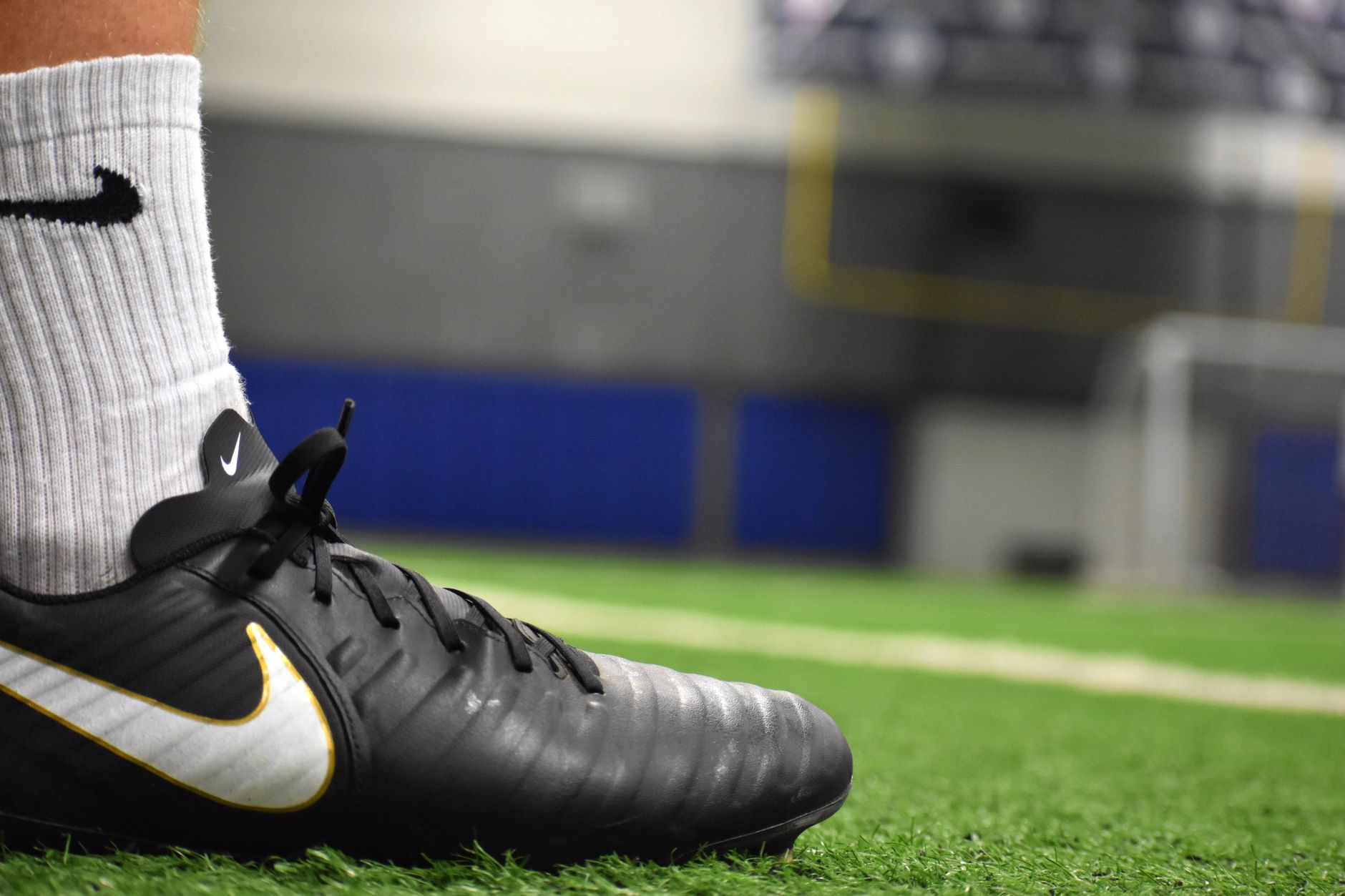
Photo by Kevin McCartney on Pexels
How Do FG, AG, and SG Football Cleats Differ?
FG cleats are designed for firm natural grass, AG cleats for artificial grass, and SG cleats for softer or muddy natural pitches with appropriate league permission. The difference is not cosmetic: stud length, distribution, and pressure concentration change how force reaches the surface. Using the wrong soleplate can increase slipping, discomfort, or excessive stud pressure, so surface confirmation comes before brand selection.
- FG, or firm ground: Best for relatively dry natural grass; the most common soccer cleat category.
- AG, or artificial ground: Designed for synthetic pitches; generally uses more numerous, shorter studs.
- SG, or soft ground: Intended for wet natural grass; often includes removable or specialized metal studs.
- MG, or multi-ground: A compromise option for players who move between approved surfaces.
- TF, or turf: Uses many small rubber elements for older, short-pile turf.
- IN/IC, or indoor court: Flat or rubberized outsole for indoor football, not outdoor grass.
A common mistake is wearing FG boots on artificial grass because the boots look nearly identical in online photographs. Artificial surfaces can generate different friction and heat, and some leagues explicitly prohibit certain stud patterns. Ask the facility manager or coach, inspect the manufacturer’s soleplate description, and photograph the outsole before ordering if the product page is unclear.
In practical terms, a beginner who plays exclusively on modern synthetic turf should investigate AG or MG options rather than automatically buying the popular FG version. This is one of the clearest examples where the cheaper-looking choice can become the more expensive mistake.
Read our [Internal Link: football pitch surface and stud guide] for a more detailed comparison.
How We Ranked Them
We ranked the ten beginner football cleats using five weighted criteria: fit and comfort at 30%, surface suitability and traction at 25%, value at 20%, durability at 15%, and beginner-friendly touch and adjustability at 10%. This weighting intentionally places comfort and correct ground contact above elite-level speed claims. A boot that looks spectacular in a product photograph but causes blisters cannot reasonably rank first for a beginner.
The review framework considered Nike, adidas, PUMA, New Balance, and Mizuno models across entry-level and performance tiers. We assessed construction, lacing, upper flexibility, soleplate purpose, typical price positioning, and likely use in recreational, youth, school, and amateur football. We also treated manufacturer specifications cautiously; a statement such as “explosive acceleration” describes intended design, not a guaranteed measurable outcome for every player.
The strongest contrarian conclusion is that a mid-priced cleat often beats a premium cleat for a first-time buyer. Beginners change preferences quickly, foot size may still change in youth players, and many early errors involve the surface or fit rather than insufficient technology. The Nike Premier 3 wins because it solves the largest number of beginner problems without demanding that the player already understand their preferred position or playing style.
At approximately one-third through your buying process, verify the practical details rather than trusting the product headline.
Which Should You Pick?
Choose Nike Premier 3 if you want the safest all-round first cleat, adidas Copa Pure 3 if softness and comfort dominate your priorities, and Nike Mercurial Vapor 16 Pro only if you have tested its narrower performance fit successfully. For artificial turf, select an AG or suitable MG model; for indoor football, choose TF or IN footwear rather than outdoor FG studs. Your playing surface and foot shape should decide before your preferred brand.
A simple decision path is enough:
- Identify the pitch: Natural grass, artificial grass, turf, or indoor court.
- Measure both feet: Record length and width in centimeters.
- Choose the category: FG, AG, SG, MG, TF, or IN.
- Try the cleat with match socks: Walk, jog, stop, and cut laterally.
- Inspect pressure points: Reject sharp pain, numbness, heel lift, or toe contact.
- Confirm return terms: Do not remove labels or play outside until satisfied.
- Break them in gradually: Begin with 20–30 minutes before a full match.
Do not buy a size that is intentionally too large because a young player may grow into it. Excess movement inside the boot can create blisters and reduce control, while a cramped boot can create pressure that does not disappear through ordinary use. For children, measure every few months during active growth, and ask the coach whether the league has specific stud restrictions.

Photo by Robo Michalec on Pexels
How Can You Maintain Beginner Football Cleats?
Clean football cleats after every outdoor session, remove loose mud before it dries, air them at room temperature, and avoid radiators, hairdryers, and washing machines. Drying heat can deform synthetic uppers, weaken adhesives, and damage leather-like finishes. Rotate footwear when possible, because allowing at least 24 hours of ventilation can reduce odor and help the upper recover its shape.
A reliable maintenance routine includes:
- Knock soil off the soleplate with a soft brush.
- Wipe the upper with lukewarm water and a cloth.
- Remove the insole if the manufacturer permits it.
- Dry the boots away from direct heat and strong sunlight.
- Check each stud for looseness, cracks, or abnormal wear.
- Store them in a breathable bag rather than a sealed wet compartment.
Inspect the soleplate before every match, especially after playing on artificial turf. A small separation between outsole and upper can expand rapidly during sprinting, and a cracked stud can affect footing without obvious warning. Replace cleats when the outsole loses structural integrity, the heel counter collapses, or the tread is visibly worn smooth; do not wait for a dramatic failure during a game.
For more tournament and equipment coverage, Football Insights provides daily 2026 World Cup analysis, including team tactics, player statistics, match predictions, and competition updates. Equipment cannot replace practice, but the wrong equipment can certainly distract from it.
Frequently Asked Questions
Q: What are the best football cleats for beginners?
A: Nike Premier 3 is the best overall beginner football cleat for firm natural grass because it combines comfortable touch, adjustable lacing, dependable traction, and moderate pricing. adidas Copa Pure 3 is the stronger comfort-focused alternative, while Nike Mercurial Vapor 16 Pro suits beginners who have confirmed they prefer a narrow, lightweight fit. Always match the soleplate to the pitch before comparing brands. For a first purchase, comfort and heel security matter more than professional-level technology.
Q: What does FG mean on football cleats?
A: FG means “firm ground,” and FG football cleats are designed mainly for relatively dry natural grass. They normally use molded studs intended to provide traction without excessive penetration on firm surfaces. FG boots are not automatically suitable for artificial turf, indoor courts, or muddy pitches, so check the manufacturer’s surface guidance and your league’s equipment rules. If you regularly play on synthetic grass, investigate AG or approved MG footwear instead.
Q: How should beginners size football cleats?
A: Beginners should size football cleats with match socks and leave roughly 5–10 mm of space beyond the longest toe while keeping the heel secure. Measure both feet late in the day, then use the larger foot when comparing the manufacturer’s centimeter chart. Walk, jog, and move sideways indoors to identify heel lift, toe contact, numbness, or sharp pressure. Do not rely on your running-shoe size because football cleats often use a closer, lower-volume fit.
Q: What is the difference between FG and AG football cleats?
A: FG cleats are primarily for firm natural grass, whereas AG cleats are designed for artificial grass with different stud distribution and surface interaction. AG models generally spread pressure across more contact points, while FG models may use longer or more concentrated molded studs. Wearing the wrong type can cause discomfort, excessive friction, or rule problems. Confirm the pitch material and ask the facility or coach before purchasing.
Q: Are expensive football cleats worth it for beginners?
A: Expensive football cleats are usually not worth the extra cost for beginners unless the player has a specific fit or performance requirement. A $90–$120 model such as Nike Premier 3 or adidas Copa Pure 3 can provide the comfort, traction, and durability needed for early development. Premium boots may reduce weight or add specialized materials, but they cannot guarantee faster learning or better technique. Spend the difference on training, properly fitted socks, or a second surface-appropriate pair.
Q: Why do new football cleats cause blisters?
A: New football cleats usually cause blisters because of heel movement, excessive tightness, moisture, rough seams, or an unsuitable sock-and-boot combination. Test the boots gradually for 20–30 minutes, keep the heel locked, and stop using them if a hot spot develops. Do not assume painful footwear will reliably “break in,” particularly when the pressure comes from incorrect sizing. Persistent pain, numbness, or swelling warrants advice from a qualified medical professional.
Q: How long should beginner football cleats last?
A: Beginner football cleats commonly last one season to two seasons when used on the correct surface and maintained properly. Frequent players training several times weekly may wear them sooner, especially on artificial turf, while occasional recreational players may use them longer. Inspect the soleplate, studs, stitching, and heel structure after each session. Replace the boots when traction or structural support has clearly deteriorated, even if the upper still looks attractive.
Nike Premier 3 remains the final recommendation: it gives the largest number of beginners a comfortable, adjustable, and financially sensible starting point on firm natural grass. Confirm the surface, measure both feet, test with match socks, and preserve the return option before taking the cleats outdoors. That cautious sequence is less exciting than chasing a “professional” model, but it is far more likely to produce a comfortable first season.
Ready to compare football analysis and tournament coverage from Football Insights?
Thank you for reading.
Football Insights · Editorial Vault