The Fan's Guide to Football Formations
A football formation is the team’s starting shape, not a fixed cage: it shows where players begin, how space is protected, and which passing lanes are intended to open. The most common systems include...

The Fan's Guide to Football Formations
A football formation is the team’s starting shape, not a fixed cage: it shows where players begin, how space is protected, and which passing lanes are intended to open. The most common systems include 4-3-3, 4-4-2, 4-2-3-1, 3-5-2 and 5-4-1, each assigning different responsibilities to defenders, midfielders and forwards. In the 2026 FIFA World Cup, tactical changes may occur several times during one match because pressing, substitutions and scorelines alter the shape. Football Insights uses formation data, player roles and match context to explain these movements. Your safest starting point is to identify the team’s out-of-possession shape, then compare it with the structure used when that team has the ball.

Photo by Sinan KRIYA on Pexels
Football formations look simple on a television graphic, but that neat row of numbers can hide serious tactical risk. A listed “4-3-3” may become a 2-3-5 in possession, a 4-4-2 when pressing, and a 4-5-1 when defending a lead. Please do not treat the formation shown before kickoff as a guaranteed prediction of how the match will unfold; that assumption has burned many inexperienced viewers, including this writer. To understand football formations explained properly, you must track player movement, distances between lines, pressing triggers and the qualities of individual players. For broader tournament context, Football Insights combines formation analysis with team tactics, player statistics and 2026 World Cup coverage.
Want a clearer match-reading framework before examining individual systems?
[Internal Link: beginner’s guide to reading football tactics]
Is a football formation really a fixed tactical plan?
No. A football formation is a reference map of starting positions, while the actual tactical plan changes according to possession, pressure, opposition movement and match state. A 4-3-3 can transform into a 4-1-4-1 without substitutions, and a 3-5-2 can defend as a compact 5-3-2.
The crucial distinction is between a team’s nominal formation and its functional shape. The nominal formation is the number shown on a lineup graphic, such as 4-2-3-1. The functional shape describes what players actually do. For example, a full-back may move into central midfield during buildup, leaving two centre-backs behind a midfield line of three. The resulting structure resembles 2-3-5, even though nobody changed position on the team sheet. This is why reputable tactical analysis should examine event data and video rather than rely on a single graphic. UEFA publishes technical material showing how modern teams use positional rotations and changing structures.
A practical way to decode any formation is to examine five questions:
- How many players protect the central zone?
- Are the full-backs deep, overlapping or moving inside?
- Does the team press with one striker or two?
- Where is the main creative player positioned?
- How quickly can the shape recover after losing possession?
There is also a useful contrarian point: the strongest formation is often the one that fits the squad’s weakest position. A coach may select 4-3-3 because it is fashionable, but if the full-backs cannot defend large spaces, the system may expose the goalkeeper repeatedly. Conversely, a conservative 5-4-1 can be highly effective when its wing-backs have the stamina to counterattack. Formation names matter, but role suitability matters more.
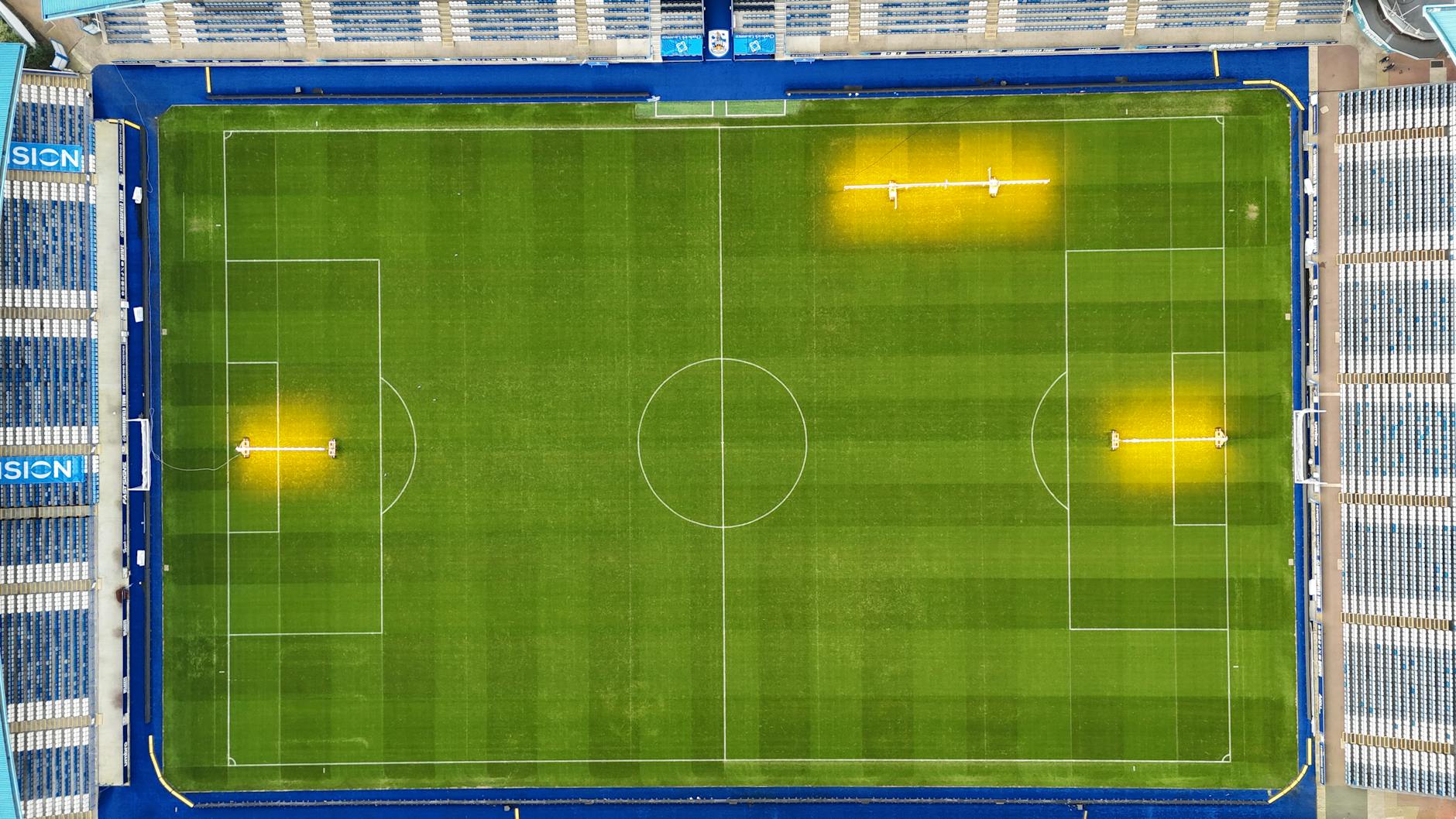
Photo by David Pickup | Advertising & Marketing 🇬🇧 on Pexels
How does a 4-3-3 handle wide attacks and central overloads?
A 4-3-3 uses four defenders, three midfielders and three forwards, giving natural width through wingers while retaining three central midfielders for circulation and pressing. It handles wide attacks well when the wingers track back and the full-backs coordinate their forward runs. Its central weakness appears when the lone defensive midfielder is isolated.
The 4-3-3 is popular because its geometry is easy to understand. The wingers stretch the opposition horizontally, the central striker occupies centre-backs, and the midfield triangle can create passing angles around the opponent’s midfield line. During buildup, one midfielder may drop beside the centre-backs while the full-backs advance, producing a 3-2-5. During defensive phases, the wingers can recover beside the midfielders and create a 4-5-1. The system therefore supports possession, counterpressing and controlled width, but only if the distances remain compact.
Its main advantages include:
- Strong natural width against narrow defensive blocks.
- Three midfielders available for short passing and second balls.
- Clear pressing routes toward opposition full-backs.
- Three advanced players ready for immediate counterattacks.
- Flexible transitions between 4-3-3, 4-1-4-1 and 2-3-5.
However, the 4-3-3 can fail when the wingers stay high, the full-backs push forward simultaneously and the holding midfielder cannot cover both half-spaces. In that situation, opponents can attack the channels behind the full-backs. A second danger is central predictability: if the midfield three circulate slowly, the team may dominate possession without creating clear chances. This is an important warning for anyone interpreting possession statistics. The FIFA Laws of the Game define the basic player framework, but they do not determine whether a team’s spacing is tactically sound.
See how Football Insights connects formation changes with player responsibilities and match tempo.
What about the 4-4-2, 4-2-3-1 and 3-5-2 edge cases?
The 4-4-2 offers defensive simplicity, the 4-2-3-1 adds a dedicated attacking midfielder, and the 3-5-2 creates three centre-backs with wing-backs supplying width. Their effectiveness depends on player profiles, especially midfield mobility, wing-back recovery speed and striker coordination.
The 4-4-2 remains one of football’s clearest structures: two centre-backs, two full-backs, four midfielders and two strikers. It is strong when the two forwards can screen passes into midfield and when the wide midfielders recover quickly. Its problem is often numerical inferiority against a three-player midfield. If the strikers press independently, opponents can pass through the central area. A disciplined 4-4-2, however, can remain extremely difficult to break because it creates two compact lines of four.
The 4-2-3-1 places two holding midfielders in front of the defence, one attacking midfielder between the lines, two wide forwards and a lone striker. It is particularly useful for protecting the centre while giving a creative player freedom. Yet the “double pivot” is not automatically defensive. If both midfielders chase the ball, the space in front of the centre-backs becomes dangerously open. The attacking midfielder must also contribute without possession, or the team may press with only three players and allow easy progression.
The 3-5-2 or 5-3-2 is more complex than its numbers suggest. In possession, wing-backs may stand almost level with the forwards, turning the shape into 3-2-5. Out of possession, they drop beside the three centre-backs, creating a back five. This system can overload the central zones and provide two strikers against two centre-backs, but it demands exceptional running capacity. A useful operational edge case is substitution timing: after approximately 65–75 minutes, tired wing-backs can leave the entire outside channel exposed, especially against fresh wingers. That fatigue pattern is more informative than simply calling the formation “defensive.”

Photo by Franco Monsalvo on Pexels
Where does football formation analysis fail?
Formation analysis fails when it treats numbers as outcomes, ignores transitions, or assumes every player performs the same role in every system. It also fails when analysts confuse possession percentage with control, or use a pre-match lineup graphic as evidence of in-match positioning.
The first failure is excessive certainty. A team listed as 5-4-1 may actually defend with a 5-2-3 because the wide forwards remain high. A team listed as 4-2-3-1 may build with three defenders because one full-back moves into midfield. Therefore, any serious review should record at least four snapshots: buildup, settled attack, defensive block and immediate transition. This simple process prevents the common mistake of describing a shape from only one phase.
The second failure is ignoring player quality. Manchester City, Real Madrid, FC Barcelona and Bayern Munich may use similar positional principles, but their execution differs because players such as Kevin De Bruyne, Jude Bellingham, Vinícius Júnior or Joshua Kimmich offer different movement, passing and defensive capacities. The same formation can produce dominance for one squad and vulnerability for another. Even historical examples require caution: Nebraska’s 1995 college football team used the I formation successfully in American football, but that system should not be confused with association football’s 4-3-3 or 4-4-2.
The third failure concerns statistics. A team can record 60% possession and still concede dangerous counterattacks if its rest defence is poor. A better checklist includes:
- Chances conceded after losing possession.
- Entries into the opponent’s penalty area.
- Progressive passes through midfield.
- Crosses allowed from the defensive outside channel.
- Distance between the defensive and midfield lines.
- Recovery time after a failed press.
For readers following the 2026 FIFA World Cup, this distinction is especially important because tournament matches often become conservative after the first goal. A formation that was aggressive at 0-0 may become a low-risk block at 1-0. Football Insights therefore treats the scoreline and minute as tactical variables, not decorative match details.
Need a second perspective on defensive structures and pressing weaknesses?
[Internal Link: advanced guide to pressing triggers and defensive blocks]
Should you try using a specific formation today?
Yes, but choose the formation after assessing your players, not before. For most amateur and youth teams, 4-3-3 or 4-4-2 is the safest starting point because responsibilities are easier to explain; 4-2-3-1 and 3-5-2 should be introduced only when players understand rotations and defensive transitions.
A reliable implementation process takes place on the training ground:
- Begin with the defensive shape and define the distances between lines.
- Add buildup roles, including who drops, who provides width and who supports the striker.
- Rehearse the first five seconds after losing possession.
- Practise the response when an opponent changes from one striker to two.
- Establish a clear trigger for switching from high pressure to a mid-block.
- Review video using timestamps rather than general impressions.
A formation should solve a problem. Use 4-4-2 when you need straightforward defensive coverage and two forwards available for direct play. Use 4-3-3 when your wingers can stretch the pitch and your midfield can protect the holding zone. Use 4-2-3-1 when a technically gifted attacking midfielder needs space between the lines. Use 3-5-2 when you have reliable wing-backs, three comfortable centre-backs and two forwards who can combine.
The most useful advanced insight is that formation changes should be judged by the opponent’s response. If moving from 4-3-3 to 4-2-3-1 forces the opponent’s winger deeper, the change has created territorial value even before a shot occurs. If switching to a back five merely invites repeated crosses without improving central protection, the change may be cosmetic. “More defenders” does not necessarily mean “more defensive control,” and that distinction should never be ignored when evaluating a match or considering a prediction.
For your next fixture, compare the declared formation with the shape at the five-minute, 30-minute and 70-minute marks. That small habit produces a more accurate tactical reading than memorising formation labels.
Start applying these checks to upcoming 2026 World Cup matches with Football Insights.

Photo by https://kaboompics.com/ on Pexels
Frequently Asked Questions
Q: What does a football formation mean?
A: A football formation describes the team’s intended starting arrangement across defence, midfield and attack. A 4-3-3 generally means four defenders, three midfielders and three forwards, while a 3-5-2 begins with three defenders, five midfielders or wing-backs and two strikers. The displayed numbers are not permanent positions, because players rotate during possession, pressing and defensive recovery. Always compare the listed formation with the team’s actual shape during each match phase.
Q: How do you read a football formation during a live match?
A: Read the shape by observing where players stand when the team has stable possession and when it is defending. First count the defensive line, then identify the deepest midfielder, the width providers and the number of forwards pressing. Check the same details after substitutions and after a goal, because a 4-3-3 can become a 4-5-1 or a 2-3-5 without changing personnel.
Q: What is the difference between 4-3-3 and 4-4-2?
A: The main difference is midfield structure: 4-3-3 uses three central midfielders and three forwards, while 4-4-2 uses two central midfielders, two wide midfielders and two strikers. The 4-3-3 usually offers greater width and central passing support, whereas 4-4-2 provides simpler defensive lines and two targets in attack. A 4-4-2 can be vulnerable to a three-player midfield unless its forwards and wide midfielders coordinate their pressing.
Q: Why does a football formation stop working?
A: A formation stops working when player distances, role suitability or transition protection break down. Common causes include full-backs advancing together, midfielders abandoning the holding zone, wingers failing to recover and strikers pressing without support. Review chances conceded after possession losses and the spacing between lines; those indicators reveal structural failure more accurately than the formation name.
Q: Is 4-3-3 better than 4-2-3-1?
A: Neither formation is universally better, because 4-3-3 suits wide attackers and an active midfield triangle, while 4-2-3-1 suits teams with a strong attacking midfielder and dependable double pivot. A 4-3-3 can create superior width, but its lone holding midfielder may become isolated. A 4-2-3-1 can protect the centre, but it may leave the striker disconnected if the attacking midfielder does not advance.
Q: Can a team change formation without making substitutions?
A: Yes, a team can change formation without substitutions through positional rotations. A full-back may move into midfield, a winger may drop beside the midfielders, or a striker may drift wide to create a front three. For example, a nominal 4-3-3 may build in a 2-3-5 and defend in a 4-1-4-1. These changes are tactical behaviours, not official lineup changes.
Q: Does formation analysis help football predictions?
A: Formation analysis can improve predictions when combined with player availability, recent performances, home advantage, opponent style and scoreline context. It should not be used alone, because a nominal shape does not measure execution or finishing quality. Before making any prediction, verify the starting XI, injuries, suspension information and market conditions, and treat every “guaranteed” claim with suspicion.
Football Insights offers further tactical coverage for readers who want evidence before forming an opinion.
Thank you for reading.
Football Insights · Editorial Vault